Key takeaways
- An electronics store outgrows a platform through its data: specifications, variants, stock in several places and the systems that read them.
- The seven alternatives split three ways: a managed service (BigCommerce), a platform you own (nopCommerce, WooCommerce, Adobe Commerce, Shopware) or composable APIs (commercetools, Salesforce).
- We rank nopCommerce first for electronics stores that want control of their code and data. We build on it, so weigh our view with that in mind.
- Test any shortlist with twenty of your hardest products before you ask for a proposal.
The warning sign is rarely traffic. It is the spreadsheet beside the store: one tab translating supplier specifications, another fixing stock counts, a third noting which app owns which checkout rule. The store still works, but every new product line adds manual work.
That is when a Shopify alternative is worth a look. Shopify can scale; the question is whether your operating model needs a different kind of control. For an electronics seller the test is how a platform handles technical product data, variants, stock, search and back-office links together.
What "Scalable" Means for an Electronics Store

A platform scales when your catalogue and orders can grow without the manual work growing with them. For electronics, check five things before you compare names.
- Structured specifications that shoppers can filter on: screen size, wattage, socket, storage.
- Variants and bundles with their own price, stock and SKU.
- Search and comparison that read those specifications, not just product names.
- Stock in more than one place, from your own warehouses to a supplier's.
- Reliable links to your ERP, product information system, marketplaces and service desk.
Then decide who should run the infrastructure. A managed service takes the hosting off your hands. An open-source platform gives you the code, the database and the hosting. A composable platform gives you APIs and leaves the storefront to your team.
Weighing a move for an electronics catalogue? BSS builds and migrates nopCommerce stores.
See nopCommerce services7 Shopify Alternatives for Electronics Stores, Ranked


We ranked them for one kind of store: an electronics retailer with a technical catalogue and back-office systems to connect. A fashion brand or a content-led shop would order them differently.
| Platform | Best fit | Why it scales | Main trade-off |
|---|---|---|---|
| 1nopCommerce | Custom B2C and B2B stores on .NET | Open source; multi-store, multi-vendor, multi-warehouse, specification attributes | Your team or partner runs hosting and updates |
| 2BigCommerce | Managed mid-market stores | SaaS with multi-storefront and B2B options | Deep custom rules depend on plan and apps |
| 3WooCommerce | Content-led WordPress stores | Open ecosystem; high-performance order storage | Plugin quality and hosting decide the result |
| 4Adobe Commerce | Complex enterprise and B2B catalogues | Company accounts, shared catalogues, customer pricing | Heavy build and running costs |
| 5Shopware | Experience-led B2C and B2B | API-first core, Rule Builder, B2B components | Features vary by edition |
| 6commercetools | Composable, multi-channel programmes | APIs that scope products, prices and stock per store | You build and run the storefront |
| 7Salesforce Commerce Cloud | Large Salesforce-centred firms | Commerce APIs tied to Salesforce CRM and service | Pays off mainly inside Salesforce |
1. nopCommerce

The pick when your product rules and integrations are your own. You hold the source, the database and the hosting, and the free core already has specification attributes, several warehouses per product and multiple stores from one install. You need a team or a partner to run it.
2. BigCommerce

The closest swap for a team that wants to stay on a managed service. It takes infrastructure off your plate and adds multi-storefront and B2B options beyond a simple direct-to-consumer setup.
3. WooCommerce

Sensible when WordPress content brings your customers in. High-performance order storage gives orders their own tables, but plugin compatibility, hosting and speed work stay with you.
4. Adobe Commerce

Built for organisations that can fund a large commerce programme. Company accounts and shared catalogues handle complex B2B pricing; budget for skilled implementation and ongoing care from day one.
5. Shopware

Worth a look when merchandising rules and B2B workflows need to change together. Map each feature you need to the right edition before you estimate cost.
6. commercetools

Right when commerce is one service inside a wider architecture. Its Stores API scopes products, prices and inventory per store; the storefront and the glue between systems are yours to build.
7. Salesforce Commerce Cloud

Strongest when customer, service, marketing and commerce already live in Salesforce. The business case should rest on that ecosystem, not on the brand.
Managed, Owned or Composable: Pick Your Model First

The shortlist changes more by how you want to run the store than by any feature list.
Three ways to run an electronics store
- Keep operations managed: start with BigCommerce.
- Own the stack: shortlist nopCommerce, WooCommerce, Adobe Commerce or Shopware by your team's skills.
- Build composable: look at commercetools or Salesforce when APIs and channels define the programme.
In our discovery calls the deciding question is rarely "which platform has this feature?" It is "where will this rule live, and who can change it safely?" A feature from an app, a feature in the core and a feature in custom code bring very different upkeep.

Write down every rule your store runs on today, and next to each one the app or person that enforces it. That list tells you which model you need faster than any demo. If you want a second pair of eyes on it, talk to our team.
Why nopCommerce Fits Electronics Catalogues

nopCommerce earns its place when the store needs direct control of specifications, pricing, checkout rules, warehouses or integrations, and the business already works with Microsoft technology. Multi-store, multi-vendor, product attributes and multiple warehouses are in the free core, with no platform subscription.
It still needs a storefront built for browsing technical products. Our NopGadget theme is one: an electronics theme bundled with 18 plugins for product comparison, filtering, quick view and a one-page checkout.

A tech-focused nopCommerce theme for gadget and electronics stores, with plugins for comparing, filtering and checking out.
Compare whole stacks, not a bare platform
A finished Shopify store is not a fair match for an empty install. Compare the whole stack: theme, search, product data, integrations, hosting, monitoring, upgrades and the people responsible for each.
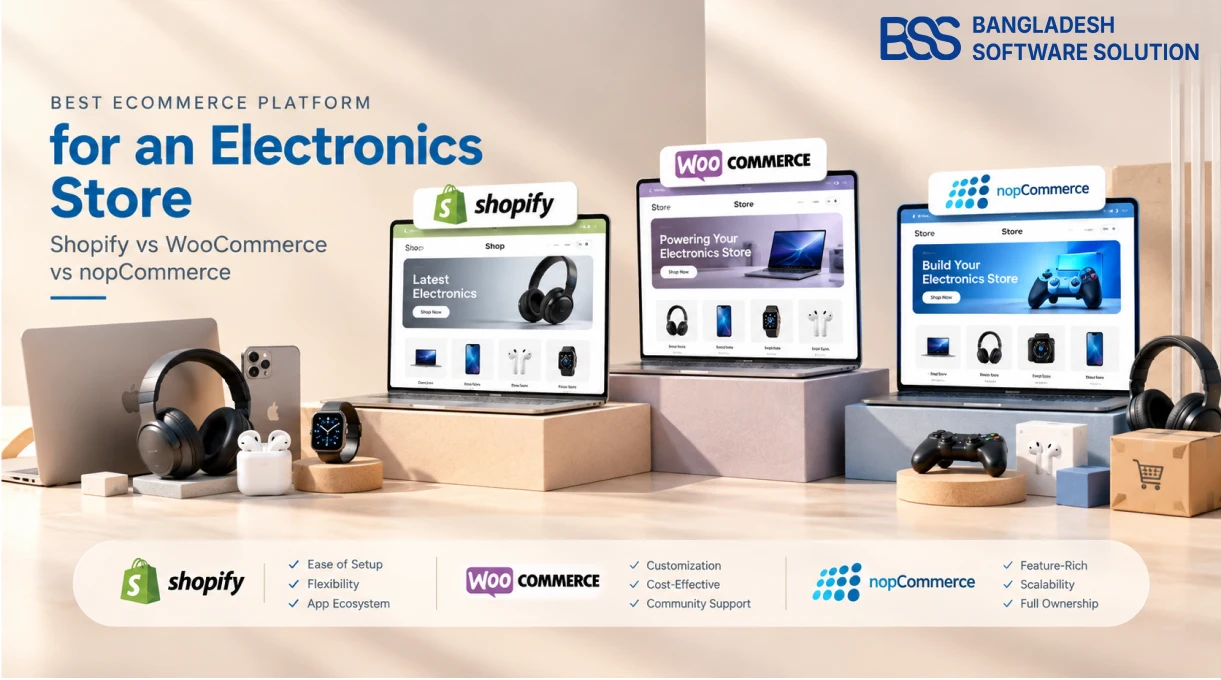
If nopCommerce is already on your list, our electronics platform comparison tests it directly against Shopify and WooCommerce.
Test the Shortlist With Your Own Products

Demos use tidy sample products. Yours are not tidy, so test with them before you ask anyone for a proposal.
- Export twenty difficult products, including variants, bundles and incomplete supplier data.
- List every system that reads or writes price, stock, customer and order data.
- Prototype search, comparison and mobile product pages with that real content.
- Price implementation, licences, hosting, extensions, support and upgrades over three years.
Read each platform's own documentation on how it stores orders and stock while you do this. It tells you more about scale than a feature grid does.
When a migration is the right call, the redirects matter as much as the data. Our Shopify to nopCommerce migration guide covers data mapping, redirects and launch checks.
An electronics store built around your catalogue
Send us your hardest products and the systems your store must talk to. We will tell you honestly whether nopCommerce fits and plan the build around them.
Frequently Asked Questions
Final Thoughts
Go back to the store held together by supplier tabs and app notes. The right replacement turns those exceptions into product data and workflows you can trust.
Pick your operating model first, test with your hardest products, and price the whole stack over three years, not the demo.
Tell us about your catalogue and the systems it must talk to. We will help you choose and plan the move.
Talk to an expert